
Use Case: Product Security & Compliance

Without Security Checks – A Blind Spot for Third-Party Dependencies
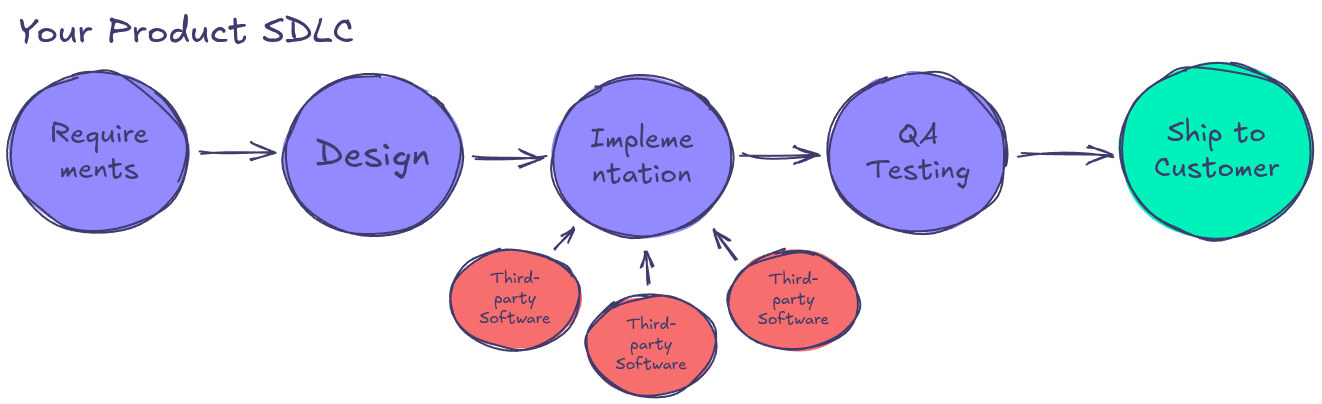
In an SDLC without any security checks, software is developed and shipped without any form of vulnerability analysis. This is particularly risky because modern applications often rely on third-party software components, including open-source libraries, proprietary modules, and precompiled binaries. The absence of security checks means that vulnerabilities, backdoors, or malicious code hidden in these dependencies remain undetected. Additionally, transitive dependencies, pulled in indirectly through third-party libraries further expand the attack surface. Without visibility into these external components, organizations risk exposing customers to supply chain attacks, unpatched vulnerabilities, and compliance failures.

Source Code Scanning – The Visibility Gap
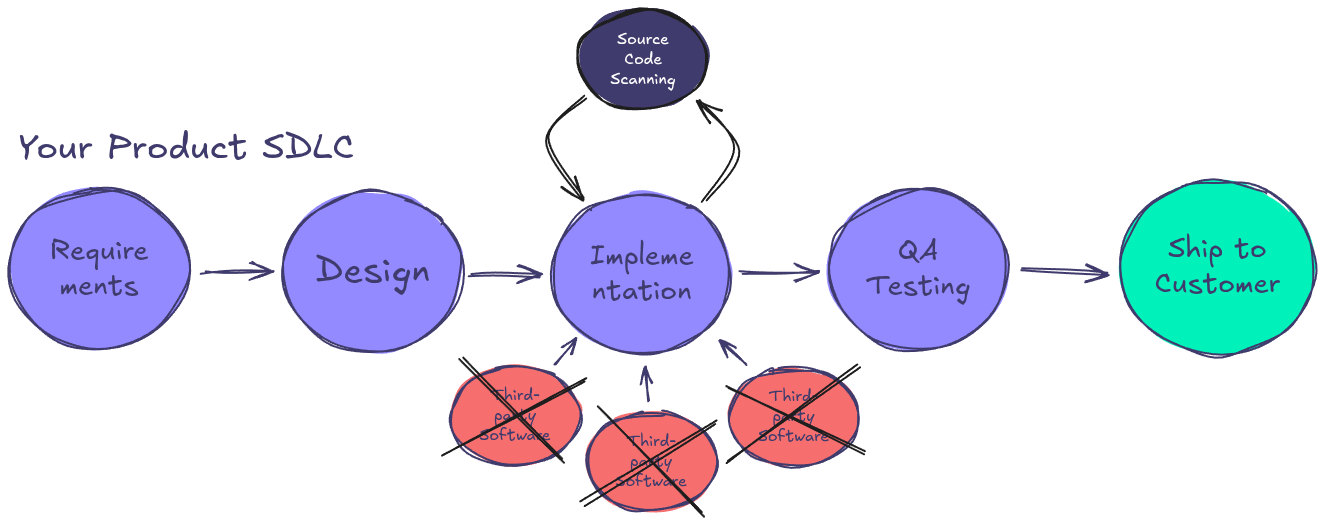
Source code scanning introduces security validation during the implementation phase by analyzing first-party code for vulnerabilities such as injection flaws, buffer overflows, and insecure configurations. However, it has a critical limitation. It only works on code that is accessible to the development team. Many software components, including third-party dependencies and transitive dependencies, are often delivered as binaries without access to the source code. If a vulnerable or malicious library is included as a dependency, but its source code is unavailable, source code scanners cannot detect security risks within it. Additionally, modern software supply chains frequently use dynamically linked dependencies, meaning vulnerabilities can be introduced without direct modifications to the source code. This limitation in visibility leaves security teams with blind spots, as they cannot verify the security of third-party or precompiled components before build or deployment.

SDLC with Binary Scanning – Closing the Gaps
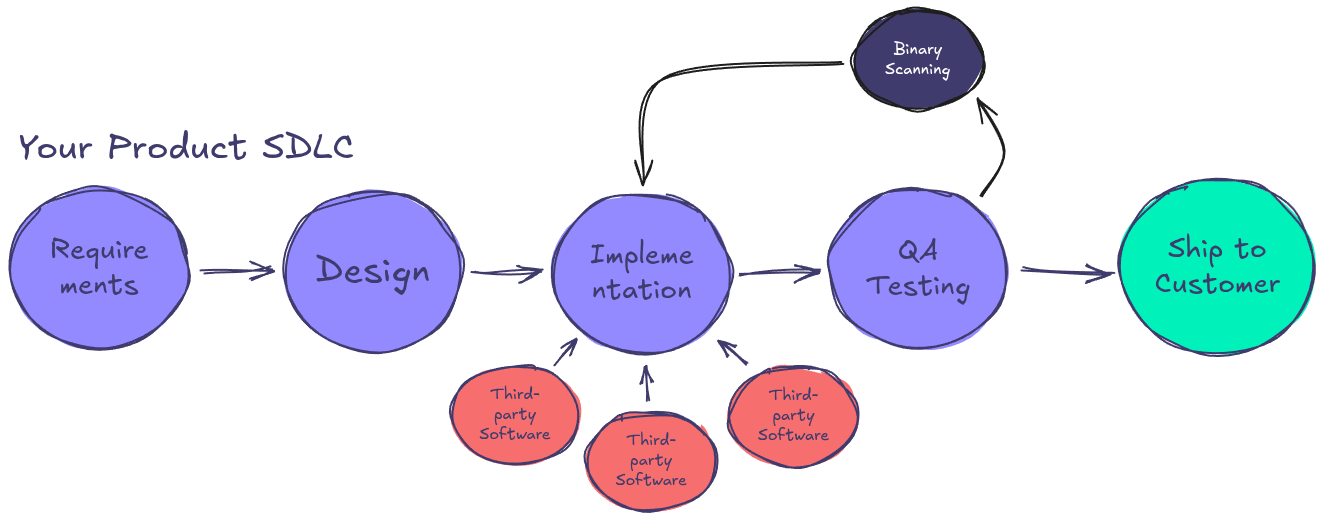
Binary scanning, such as that provided by the Binarly Transparency Platform, overcomes the limitations of source code scanning by analyzing compiled binaries, including third-party and transitive dependencies. Unlike source code scanning, which requires access to raw code, binary scanning works on the final software artifact, meaning all embedded components, linked libraries, and firmware are scanned for vulnerabilities. This approach is particularly effective because:
  • It detects vulnerabilities in third-party and transitive dependencies that source code scanning cannot analyze.
  • It provides visibility into proprietary and precompiled software components, including drivers, firmware, and closed-source libraries.
  • It is easier to implement because it does not require access to the original source code, eliminating the need for vendors to disclose proprietary code.
  • It integrates later in the SDLC, allowing security teams to validate software integrity right before release, reducing last-minute surprises.
Binary scanning is easier and more efficient than source code scanning because it removes the need for extensive dependency tracking. Security teams can simply scan the final compiled software to identify vulnerabilities across the entire code-base both first-party and third-party without having to manually inspect or decompile individual source files. This makes binary scanning a more practical and scalable approach for securing modern software supply chains.